
In this Spotlight on SDNQ we focus on superstitions, customs and traditions in Somerset and Dorset surrounding Good Friday, as revealed in the back issues of SDNQ.
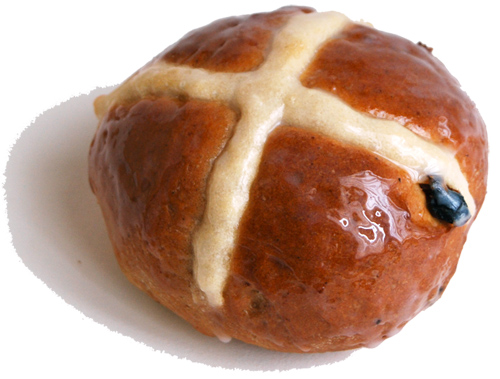 Good Friday is the day that Christians commemorate the crucifixion of Jesus Christ. It has been suggested that ‘Good’ may be a corruption of ‘God’s Friday’ or that it refers to its status as a holy day. Hot Cross Buns, made using a spiced and fruited dough with a cross marked on the top, are traditionally eaten on Good Friday, as recalled by the nursery rhyme, ‘Hot cross buns, hot cross buns, one a penny, two a penny, hot cross buns.’
In the 1894, William Macmillan of Ochiltree House in Castle Cary, submitted to SDNQ (vol.4) three West Country superstitions relating to Good Friday:
The first superstition concerned the belief that the flowers of seeds sown at 12 o’clock on Good Friday would come up double.
Secondly, the superstition that it was unlucky to throw away soapy water on Good Friday. This tradition was also later reported in SDNQ in 1911 (vol. 12) by the Rev. Henry Farley, formerly vicar of Lytchett Minster, who had been told by an old Dorset woman, aged about 80, that her grandmother had taught her never to throw away soapy water on Good Friday. The Rev. Farley suggested that this belief was prevalent in Dorset where it was believed that soapy water thrown away on Good Friday turns to blood.
Thirdly, the superstition of slitting the ears of calves on Good Friday to prevent ‘quarter-oil’ in a ‘weanling’ calf – though only the ear on the milking side was slit. This superstition was also referred to by the Rev. Charles William Penny of Wokingham (formerly Bursar at Wellington College) who reported in SDNQ in 1897 (vol.5) that in South Perrott it was the tradition that farmers would cut the ears of calves on Good Friday in order to ward off a sickness called ‘The Evil’. It was believed that the operation would only work if the farmer had attended church immediately beforehand.
In the 1946 issue of SDNQ (vol.24), Joseph Fowler, the Dorset Editor of SDNQ, provided transcripts of the churchwardens’ accounts for Sherborne All Hallows church, which included references to the customs surrounding Good Friday and Easter Day. The churchwardens’ accounts for 1525-1526 included payments for making ‘Judas clappers’ (6d.), a ‘Judas crosse’ (16d.), and for ‘wachyn of ye sepulkar’ (12d.). Fowler explains that the ‘Judas clappers’ took the form of a rattle which was used instead of the usual bell for all church ceremonies after the Gloria in the Mass of Holy Thursday up to the Gloria in the Mass of Easter Eve, and was also used instead of a bell for summoning people to church between those times. The ‘Judas crosse’ was a triangular candlestick used at the Office of Tenebrae during Holy Week, and was also known as the Lenten herse light. The reference to ‘wachyn of ye sepulkar’, Fowler explains was a usual custom when the clerk or bedemen watched the Sepulchre from Good Friday evening until early Easter Day morning. The watchers were also given money to buy coals to keep themselves warm.
Dr Eric John Holmyard discussed in SDNQ in 1913 (vol.13) the history of Midsomer Norton Fair which was traditionally held on Good Friday. Holmyard quotes from John Norden’s survey of the manor in 1611, which states that ‘on Good Friday there was a Fair or Market in the village of Norton’, and that the Reeve or Bailiff of the manor used to ‘erect Stalls and collect for the use of the Lord all Tolls and profits of the said market which at this time scarcely amount to more than 10s., 12s., or 14s.’ However, by 1789, the date of the Fair had been moved to St Mark’s Day (25th April). Having fallen into abeyance, the fair was revived in 2011 by the Midsomer Norton Community Trust.
Two Good Friday and Easter Day weather rhymes found in North and South-West Dorset are recounted in the 1905 issue of SDNQ (vol.9) by Edmund Nevill and the Dorset Editor of SDNQ, C.H. Mayo:
‘A fine Good Friday and Easter Day,
Little grass and all good hay.’
‘Whenever it’s wet on Easter Day,
There’ll be plenty of grass, but little hay.’
Visit Spotlight on SDNQ to discover more research themes.