
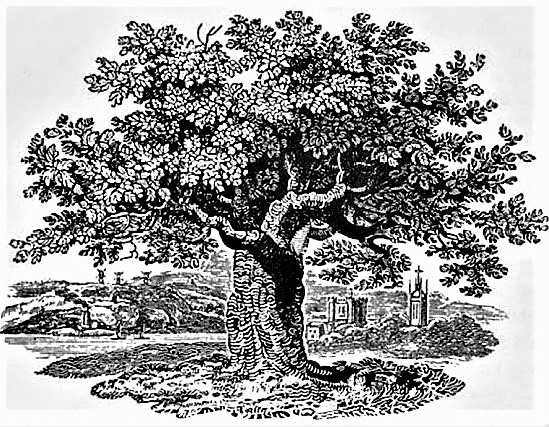
Oak Apple Day, or Royal Oak Day, is traditionally celebrated in England on 29th May. The day commemorates the Restoration in 1660 of Charlies II to the throne. Charles II’s birthday, the 29th May, was chosen by Parliament ‘as a day of thanksgiving for our redemption from tyranny and the King’s return to Government’. On Oak Apple Day people demonstrated their support for the monarchy by wearing oak leaves or an oak apple to commemorate when, in 1651, Charles II hid in an oak tree to avoid capture.
In the West Country, Oak Apple Day was known by alternative names, as revealed by contributors to SDNQ who identified Shig-Shag Day (South West), Shit-sack Day (Winchester), Shit-Shac Day (North West Somerset and North Devon), Shitsac Day (Wiltshire), Shick-shack Day (Surrey), and Shits ac Day! It was suggested that these names may have been corruptions of the Old English word for oak – ‘ac’ – and that ‘shit-sac’ was a Wiltshire word for ‘oak apple’.
In the following article, first published in SDNQ in September 1998 (vol.34, pp.243-248), Dr J.B. Smith investigates the possible derivations of these West Country names for Oak Apple Day:
Shick-Shack day involved the now obsolete custom of wearing until noon on May 29th, Royal Oak Day, an oak apple or a piece of oak with an oak apple attached, when anyone not displaying such a sprig, or otherwise not entering into the spirit of the celebrations, would be berated, but also possibly bonneted and pinched, pelted with rotten eggs, or, most commonly, stung with nettles into the bargain. The verbal abuse usually contained some variation on the word shick-shack, plus the occasional reference to Cromwell. Thus in Hampshire those withholding largesse from the purveyors of oak galls had to put up with:
“Shig-shag, penny a rag,
Bang his head in Cromwell’s bag,
All up in a bundle.”
Now Richard Mabey tells us that in Dolton, Devon, chick-chacks, the local name for oak galls, that is ‘marble galls’, carried about on 29 May derived ‘from the sound they make when used as marbles’.[1] One suspects Doltonian popular etymology at the back of this. When, on the other hand, Ronald Hutton, extremely cautiously, it must be admitted, repeats as ‘the only plausible explanation suggested so far’ the view that shick-shack is to be associated with ‘the biblical villain Shishack, King of Egypt’, who took treasures from Jerusalem and could thus, presumably, be equated in some ways with Cromwell, we have what might be termed ‘antiquarian etymology’.[2]
In fact, a persuasive explanation for shick-shack and its variants has long been available. As Bushaway reminds us, it is probable that the expression originated in the slang name shit-sack, a term of abuse specifically applied to Protestant dissenters in the late seventeenth century.[3] Entirely in harmony with this, citing Granger’s Biographical History of England of 1769, no less an authority than The Oxford English Dictionary states under the headword shick-shack: ‘Perhaps a corruption of shitsack an “opprobrious appellation by which the Nonconformists were vulgarly distinguished” ’. It continues with the information that shick-shack, ‘apparently originally used as a term of abuse for persons who were found not wearing the customary oak apple or sprig of oak on the morning of Royal Oak Day’, then in some places became a name for the oak apple or sprig of oak itself. A nice example of metonymy, in other words.
This interpretation becomes all the more convincing when we peruse the quotations which follow the above explanation. In these we discover variants of shick-shack that are closer to what must have been the original form. Thus shitsac (1847) for ‘oak apple’ in Surrey, and the Wiltshire Shitsack Day, ‘when the children carry shitsack, or sprigs of young oak’ (1896). By contrast, the first citation, from G. Robert’s History and Antiquities of Lyme Regis (1834), has a coy but tell-tale reference to an ‘opprobrious name’ for those not displaying an oak leaf, or wearing it after midday.[4]
To the examples given in evidence above we may add the expressions chitjack and shitsack, applied at Barford St Martin in Wiltshire to the sprigs of oak worn on King Charles’s Day, in New Forest sheets-axe, a term of derision flung in faces of children unequipped with oak apples on that day, and the name given to the festival at South Cadbury as well as in more westerly parts of Somerset, namely Shitsack Day.[5]
As Bushaway points out, numerous rhymes embodying our ‘opprobrious appellation’ hint at its denominational background. Take, alongside the above-quoted Hampshire example naming Cromwell, the south-western ‘Shit-sack, Lousy-back, Go and tell the Lord of it’. Then there is the taunt which Ruth Tongue says was chanted by wearers of oak leaves in Taunton as late as 1904 and in Chard up to 1910: ‘Royal Oak, the Whigs to provoke,’ to which their opponents, who favoured a different emblem, would respond: ‘Plane trees leaves, the church folk are thieves.’[6]
Since Platanus hardly plays a part in folk life or folklore, we may perhaps take it that ‘plane tree’ here refers to Acer pseudoplatanus, the sycamore, as in some northern dialects.[7] In Cornwell, this tree was called the faddy, because of its association with the dance of that name at Helstone on May 8th, and, even more to the point, it was also the may or may-tree, because of its links with May Day,[8] a festival that lost many of its attributes to Royal Oak Day. My suggestions is thus that, while the royalists embraced the oak tree as an obvious symbol of Royal Oak Day, their antagonists resorted to the sycamore, thus seizing upon an emblem that originally belonged to May Day. The sectarian nature of Royal Oak Day is also reflected in the nickname Papish, a noun which generally meant ‘Papist, Catholic’, but was in East Yorkshire applied more specifically to boys who did not wear oak twigs in their hats on May 29th.[9]
Our main point so far has been that shick-shack must be a variation on a more forthright expression. Whether or not euphemism, or just linguistic wear and tear has been responsible for diverting shit-sack from its original form and meaning, these have been persistently disregarded, as has an anecdote purporting to explain the appellation. A version of this anecdote is to be found for instance in Grose, following the headword Sh-t Sack and its definition as ‘A dastardly fellow: also a non-conformist’.[10] Grose’s ultimate source for the anecdote must be Granger’s above-mentioned Biographical History, where the name Sh-t Sacks is explained as having its origin in the reign of Charles II as follows:
‘As the laws, in this reign, were very severe against all religious assemblies which were not of the established church, the Nonconformists sometimes met in very obscure places in the country. There is a tradition, that a congregation of Protestant Dissenters were assembled in a barn, which frequently harboured beggars and other vagrants, and that the preacher, for want of a ladder or a tub, was suspended in a sack affixed to a beam. He preached that day upon the last judgement, and towards the close of his sermon, entered upon a description of the terrors of that tribunal. He had no sooner mentioned the ‘sounding of the trumpet,’ than a strolling mimic-trumpeter who lay concealed in the straw, began to exert himself. The congregation, struck with the utmost consternation, fled in an instant from the place, and left the affrighted preacher to shift for himself. The effects of his fright are said to have appeared at the bottom of the sack, and to have occasioned that opprobrious appellation by which the Nonconformists were vulgarly distinguished. This idle story, which was communicated by a Dissenting minister, was propagated throughout the kingdom, in the reign of Charles II.’[11]
Many have dismissed this explanation of shit-sack as fanciful, irrelevant, or offensive. So it may be, but that does not diminish it significance, both as a piece of folk-narrative, and as a symptom of its times. Especially common among folk tales are stories about parsons and congregations, and there is one particular tale-type, ‘Application of the Sermon’, in which the words of a preacher are taken literally by a native listener. Thus in one sub-type the parson asks from the pulpit: ‘Where shall we place the Prophet Ezekiel?’, to which an old man in the congregation inappropriately responds: ‘He can have my place; I’m going home.’[12]
The sub-type which interests us, however, is that in which the preacher says: ‘Let Gabriel blow his horn! At this, a boy hidden in the loft blows a trumpet, causing preacher and congregation to scatter. Examples of this sub-type have been collected from New York and Kentucky.[13] What seems to have been overlooked to date is that Granger’s anecdote must be the prototype of these. Admittedly the offshoots, in which the preacher takes to his heels with the congregation, are less complex than the prototype, in which the preacher is suspended in a sack and is thus unable to join the stampede. Apocryphal though they may well be, the very circumstances in which he has to give his sermon speaks volumes about contemporary attitudes to Nonconformists and the conditions they had to tolerate.
We return briefly to Royal Oak Day. It is symptomatic of the imprint left by the royal oak on the national psyche that Royal Oak Day absorbed many features of May Day, as mentioned above. As George Roberts indicates, the bunches of nettles still to be found outside some Lyme Regis houses on the morning of Royal Oak Day in the early nineteenth century harked back to those used to shame dissenters who, in Charles II’s reign, refused to celebrate his restoration.[14] In fact it is likely that nettles and the nettling of those who would not make common cause with the majority were originally a feature of May Day.[15]
Another small example of the royal oak’s power as an icon is provided by the belief that making a cut through a fern stem or root will reveal the image of an oak tree. Indeed, the belief must have given the common bracken its dialect name oak-fern, recorded for West Somerset as well as for Norfolk. More specifically, some thought the image to be that of King Charles hiding in the Boscobel Oak.[16] At the back of such beliefs is the widespread tradition that many plants displayed the true figure of the cross. Take for instance the Cotswold story of how a disbeliever is converted on discovering an image of the cross in the middle of a chunk of wood he has just sawn through.[17] As far away as China, some people would invariably eat bananas with a fork, for fear that a cut with a knife should reveal the crucifix clearly represented in the medulla.[18] Nearer home, there was in Scotland a childish game called ‘Holy Bracken’, which involved severing a stem of bracken to reveal the initials ‘J.C.’, taken to be those of Christ. In England, by contrast, the object of the corresponding game was to find King Charles in his oak. Compare the Irish belief that a similar cut through a fern would reveal the initial of the chief who once owned the land where the fern was found growing.[19] All of which demonstrates, if nothing else, the great capacity of oral tradition for ringing the changes on the same fundamental theme.
Footnotes:
[1] Richard Mabey, Flora Britannica (London, 1996), p.77.
[2] Ronald Hutton, The Stations of the Sun (Oxford, 1997), pp.292-293. Cf. the review of this by Malcolm Jones in Folklore, 108 (1997), 137-140, esp.139.
[3] Bob Bushaway, By Rite (London, 1982), p.74.
[4] J.A. Simpson and E.S.C. Weiner, The Oxford English Dictionary, 2nd ed. (Oxford, 1989), 15, 251 and 287.
[5] Joseph Wright, The English Dialect Dictionary (1898-1905, reprinted London, 1970), 1, 591 and 5, 380; J.A. Bennett, SDNQ, 1 (1890), 124, note 184.
[6] Bushaway, pp.74-75; SDNQ, p.74, note 185; R.L. Tongue, Somerset Folklore, ed. K.M. Briggs (London, 1965), p.163.
[7] Joseph Wright, The English Dialect Dictionary (1898-1905, reprinted London, 1970), 4, 537; Geoffrey Grigson, The Englishman’s Flora (1958, reprinted Oxford, 1996), p.113. The fact that plane for ‘sycamore’ shows every sign of being restricted to these dialects, together with the fact that Tongue’s rhyme echoes word for word one recorded by Brand for Newcastle-Upon-Tyne, makes me suspect that her memory has in some way played her false here. See W.C. Hazlitt, Dictionary of Faiths and Folklore (1905, reprinted London, 1995), p.456 under ‘Oak Apple Day’.
[8] Joseph Wright, The English Dialect Dictionary (1898-1905, reprinted London, 1970), 2, 275 and 4, 63; Geoffrey Grigson, The Englishman’s Flora (1958, reprinted Oxford, 1996), p.113.
[9] Joseph Wright, The English Dialect Dictionary (1898-1905, reprinted London, 1970), 4, 421.
[10] [Francis Grose] Dictionary of the Vulgar Tongue (1811; reprinted Adelaide, 1971), no page numbers, headword ‘Sh-t Sack’.
[11] J. Granger, A Biographical Dictionary of England, 2nd ed. (London, 1775), 3, 316-317 and 4, index, ‘Sh-t Sacks.’
[12] Ernest W. Baughman, Type and Motif-Index of the Folktale of England and North America (The Hague, 1966), p.48, Type 1833A.
[13] Ernest W. Baughman, Type and Motif-Index of the Folktale of England and North America (The Hague, 1966), p.49, Type 1833J.
[14] George Roberts, The History and Antiquities of Lyme Regis and Charmouth (London, 1834), p.257; John Symonds Udal, Dorsetshire Folklore, 2nd ed. (St Peter Port, 1970), p.43.
[15] J.B. Smith, ‘Holly-Beating, Nettling, Dipping, Sweet-Haying: Some British Customs in Their Wider Context’, to appear in Folk Life.
[16] Roy Vickery, A Dictionary of Plant-Lore (Oxford, 1995), p.44; Joseph Wright, The English Dialect Dictionary (1898-1905, reprinted London, 1970), 4, 316.
[17] George Edmund Hall, Willum Wurkman’s Wit and Wisdom (1915), reprinted in Cotswold Tales (Stroud, 1991), chapter 36, ‘Biblical Matters’, p.205.
[18] Hilderic Friend, Flowers and Flower Lore (London, 1886), p.190.
[19] Roy Vickery, A Dictionary of Plant-Lore (Oxford, 1995), p.44; Iona Opie and Moira Tatem, A Dictionary of Superstitions (Oxford, 1989), p.148.
Visit Spotlight on SDNQ to discover more research themes.