
The following accounts of rare bird sightings in Somerset and Dorset in the 19th century appeared in Vol. 2 of SDNQ (1891):

No.56, THE CRANE IN SOMERSET by William Bidgood, curator of Taunton Castle Museum, 3 April 1890.
On the 6th of December, 1889, a fine specimen of the Crane (Grus communis) was shot near Stolford, on the coast of the Bristol Channel. In early times the Crane was very numerous in this country, as appears from many references to it in documents and historical records. Giraldus Cambrensis states that in his time – towards the end of the 12th century – Cranes were so numerous in Ireland, that as many as a hundred might often be seen in one flock. Hawking was the favourite mode of taking them, and many instances are recorded of its having been served at grand banquets, as were also the bustard and swan. Before the middle of the 16th century, however, it was noticed that the Crane was diminishing in numbers, and an Act was passed prohibiting the taking of their eggs, a penalty being imposed. Up to this time, therefore, it would appear that they bred regularly in this country, the fen district being their chief resort. The gun, the drainage of the marshes, and the increase of population, all contributed to lessen their numbers, and it is pretty certain that for three centuries past the crane has ceased to breed in the British Islands. Considerable numbers, however, appear to have visited this country at the period of their annual migration, but during the present century it can only be looked upon as an occasional straggler to our shores.
The particular specimen now under consideration proved to be a male bird in very fine plumage, having nearly completed its moult. A few rusty feathers appear here and there, and the plumes on the wings would probably have grown a little longer, if the period of its death had been delayed for a week or two. But for all this the bird must be considered as an exceptionally fine specimen. Its weight was just under 13lbs.; length from bill to toe, 5ft. ½in.; length from bill to tail, 4ft.; expanse of wing, 7ft.; from the carpal joint to tip of wing, 1ft. 10½in.; length of tarsus, 10 ½ in.; bare space above the tarsus, ½ in.; as stuffed, the bird stands 4ft. 1in. high. These measurements seem to be rather above the average. The bird appears to have been shot whilst feeding, as the gullet was filled with beans and a few small field snails. It is in the possession of Sir Alexander Hood, of St. Audries. It is not a little singular that about 24 years ago a crane was shot by Mr Haddon, of Taunton, within a very short distance of the spot where the present specimen was killed. It was a young bird, and is still in Mr Haddon’s collection.
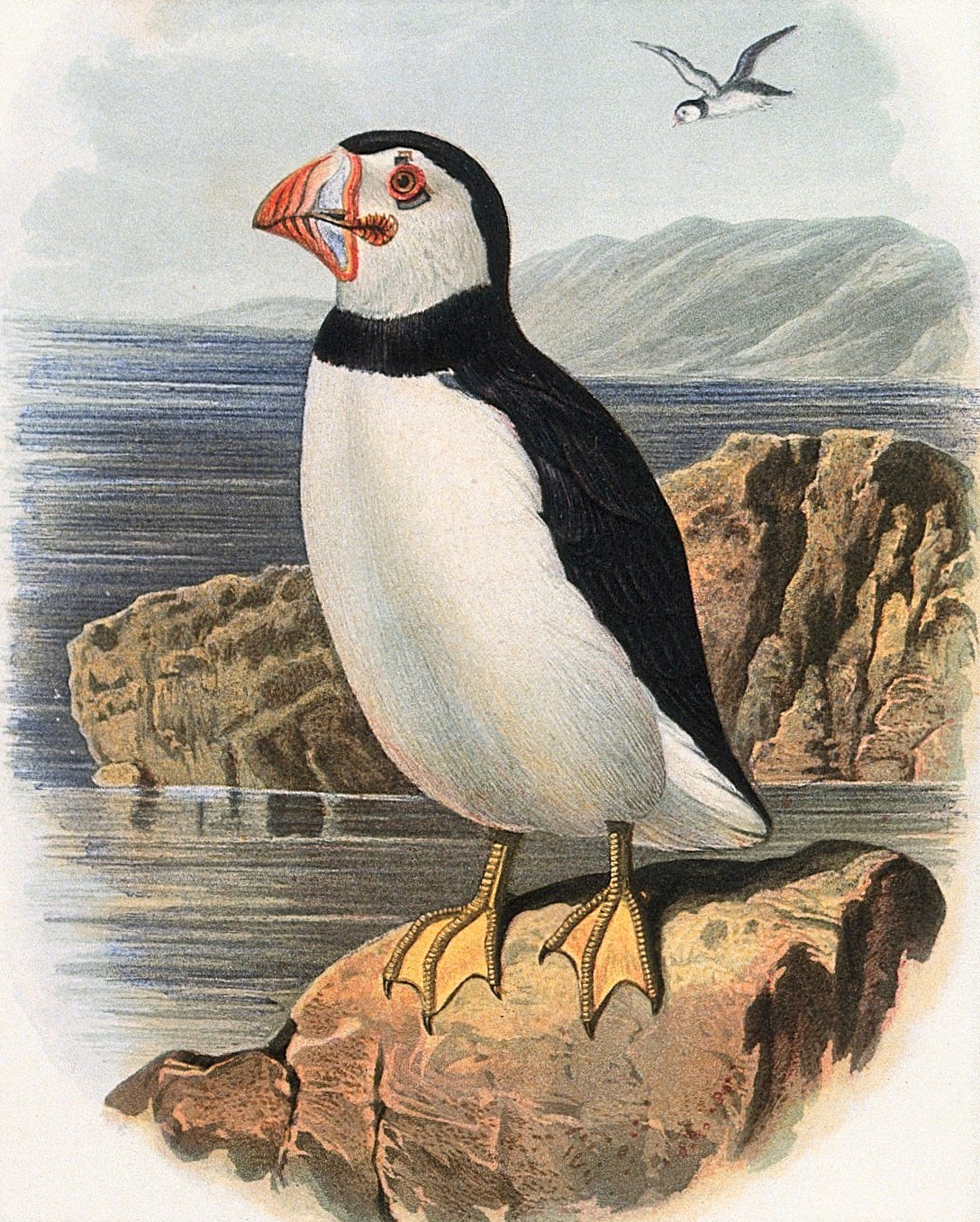
No.62, A RARE ORNITHOLOGICAL VISITOR by Hugh Norris of South Petherton (former Somerset Editor of SDNQ).
On June 16th, 1887, a strange looking bird was observed by some girls, crouching on a small tumulus in a meadow, near the river Parret, where it is crossed by the road leading from South Petherton to Martock. On approaching it, It was too exhausted to attempt escape, and the finders took it home, hoping that by careful feeding and nursing it would be revived. It was plentifully supplied with water, and it ate some slugs and small snails, but unfortunately it died in the night of the 17th, about thirty hours after its capture.
It proved to be a specimen of the Puffin (Fratercula Arctica), which is noticed by Mr W. Baker, in an article entitled ‘Somersetshire Fauna,’ in Vol. 1 of the Proceedings of the Somersetshire Archaeological and Natural History Society (1851), and again by Mr Cecil Smith, in a paper on the ‘Birds of Somerset,’ in Vol. XVI of the same Journal (1871), as “an occasional straggler on the coast.” The fact here recorded is noteworthy, inasmuch as the weather was fair and calm and had not been stormy, and the bird shewed no mark or injury. The spot where it was found is twenty miles, more or less, from the nearest point of the Somerset coast on the north, and fully fifteen from the Dorset coast on the south. A flight from the former would have been up the flat valley of the Parret; whilst from the latter, it would have involved the crossing of some of the highest ground in the neighbouring country.
NO.160, HARD WINTERS AND WILD FOWL, by H.J. Moule, Dorchester.
Hard winters drive many kinds of water birds to southern shores and rivers, as every one knows. They come to escape from greater cold in the north, as every one supposes. Yet does not the last winter bring a difficulty down on this theory? We had arctic cold in the south. Rare water birds, such as hoopers and bitterns, duly appeared, and were duly shot, near Weymouth. But the zones were transposed for the time. The more north the more mild was the air. What made the hoopers leave their native, temperate Iceland for strange, arctic Dorset?
Rachel Hassall
April 2020
Visit Spotlight on SDNQ to discover more research themes.