
The following article by Martyn C. Brown of the Somerset Rural Life Museum, was published in SDNQ, vol. 30, pp.228-237:
From our neighbouring county, Thomas Hardy, in Under the Greenwood Tree, describes the rural scene in which ‘stalwart ruddy men and boys were dressed mainly in snow-white smock-frocks, embroidered upon the shoulders and breasts in ornamented forms of hearts, diamonds and zigzags’. Descriptions such as this have fostered the idea of the countryman’s smock as the traditional garb of the farm labourer. However, very little is known about the origin of the smock and questions surround the derivation of styles and embroidery designs.
Somerset County Museum has a collection of twelves smocks now housed in the Rural Life Museum. It was a desire to discover more about the history of these smocks that led to this work. Somerset smocks in the Bristol City Museums have also been studied, as have several in private collections, in order to achieve as wide a range as possible.
The word ‘smock’ is derived from the Anglo-Saxon ‘smoce’ meaning ‘shift’, or ‘chemise’ or ‘a garment to creep into’; but the shape of a smock is more like that of a Roman ‘tunica’ which was still worn in England in Saxon times. Illustrations from early English manuscripts show labourers working in loose fitting garments reaching to their knees. It is possible that this style of dress continued to be popular throughout the Medieval period. From the Middle Ages the word ‘smock’ came to be used for a loose undergarment worn by women. In the 18th century the word became so grossly used that it was replaced by the word ‘shift’ in polite circles. That word suffered from a similar debasement and was eventually replaced by the word ‘chemise’. From the middle of the 18th century the word ‘smock’, or ‘smock-frock’, was used to describe the countryman’s garment as we now know it.
From the 17th century, illustrations of smocks, as loose protective overgarments worn usually by men, became more common. One of these, on a playing card dated 1676, shows a waggoner in a smock: ‘the smock is straight and rather full, worn to just below the knees, the opening (at the neck) reaches almost to the waist and there is a small turned down collar, there is no ‘smocking’ or decoration’.[1] From that period onwards smocks were worn as the usual clothing of outdoor rural workers, particularly shepherds and waggoners who were frequently exposed to the inclemency of the English climate. In the 18th century illustrations of smocks appear in the paintings of Constable, Morland and Rowlandson and many others.
It was not until the mid-18th century that the countryman’s smock began to be elaborately decorated. This decoration became most elaborate during the early 19th century. Various suggestions have been made to explain the origins of the embroidered designs; some thought that the patterns denoted different counties and that each county had a distinctive style; others, that the designs distinguished the various trades of the wearers and that the same designs were common to many counties.[2] Some of the patterns on smocks do certainly appear to have some symbolic significance; it is possible to identify trees, flowers, leaves, hearts and many other features in the careful embroidery of the collars and shoulder-straps.
In the 1930’s Alice Armes had found shepherds’ smocks with emblems of crooks, sheep and hurdles, and carters’ smocks with cart wheels, whips and reins, and in 1962 at a costume seminar held in Manchester, over 120 smocks were studied to test these suggestions.[3] Anne Buck, in her summary of this seminar, concluded, that ‘there is insufficient evidence to connect any of the different shapings or details with a particular occupation’. Six of the smocks studied had been worn by shepherds and yet they showed ‘no common motif in their embroidery’. The most likely solution is that the patterns, geometric forms, coils and circles, squares and lozenge shapes are the ‘basic stuff of untutored art’.
Somerset smocks certainly show no common design motif; most of them have relatively simple embroidery patterns. The most elaborate contains stylised tree or leaf forms and heart shapes on the collar and ‘box’. Four of the Somerset smocks have no embroidery at all; they are simply gathered with ‘rope’ or ‘basket’ stitch at the neck, shoulders and cuffs. It is more than likely that, though essentially protective garments, smocks were sometimes worn on special occasions; Sunday smocks have been noted in several parts of the country. Possibly the more elaborate smocks now displayed in many country museums are the exceptions; they may be heirlooms, or the wedding finery of country families – whereas the genuine traditional smock, the protective clothing, was a plain serviceable garment. There was a Somerset tradition that a pauper girl would wear only a smock to her wedding, to symbolise that she had nothing else to bring as a dowry.
Neither do Somerset smocks appear to have a similar style or ‘cut’. Half the smocks studied for this article were ‘reversible’, that is identical back and front:


Of those remaining, some were of the ‘coat’ style, with buttons all down the front. Others had only two or three buttons at the neck and no other front opening:
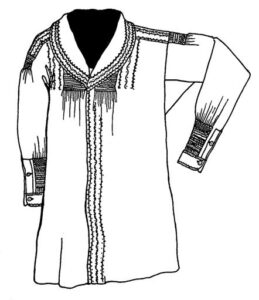
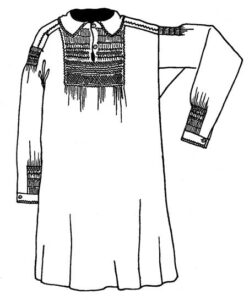
Smocks from other areas often have additional layers of material over the shoulders, presumably for protection against the weather; a good example is the Radnorshire smock in the Welsh Folk Museum[4], which has ‘tucked’ should flaps 19 inches wide and 15 inches long, virtually forming a cape. Only one of the Somerset smocks is of this design; this one, in the Bristol Museum collection, has shoulder flaps 16 inches wide and 14 inches long with very elaborate feather-stitching and a button on each shoulder.
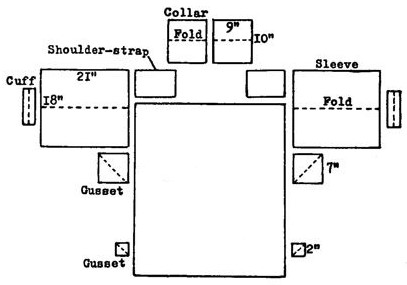
The traditional countryman’s smock is a garment of simple cut. All its parts are made from squares or rectangles of material, the measurements of which hare to some extent governed by the need to use the minimum length of material without waste. Most ‘reversible’ smocks were cut from 36 inch material, and full-size smocks are usually about 42 inches long. Two lengths of full width material were sewn together to form the body of the smock, producing a garment about 70 inches round: hence the need to gather this fullness by ‘smocking’. The use of the word ‘smocking’ for this ornamental stitching which holds gathers in place, dates from the 19th century only and is derived from the garment.
The sleeves, collar and gussets were similarly made from squares of material:
Most of the Somerset smocks are made of linen, either bleached or unbleached; the former are nearly white, the latter a pale buff colour. The quality and thickness of the material varies considerably, from finely spun linen giving an almost silken finish, to a hard-wearing coarse material ideal as a protective overgarment.
 Two children’s smocks in the Somerset Rural Life Museum’s collection are made of nankeen, a thick cotton cloth originally imported from China. These smocks are interesting in that they illustrate the debased decoration and crude embroidery of factory-made garments at the end of the 19th century. The smock on the right was worn at Williton in 1900. The other, which is almost identical, still carries a label “4-4 BOY’S. 13/-.” At that time 13/- was nearly a week’s wages for the average labourer, thus even a factory-made smock was an expensive item. The price of adult smocks during the 19th century represented to the agricultural worker a week to a fortnight’s wage[5], it is therefore not surprising that many smocks were made at home and probably passed from one generation to another. Three of the Somerset smocks are made of cotton twill or drabbet: this was a thick material not suited to delicate embroidery work, and generally of later use.
A number of colour smocks have survived from other areas, for example in Hertfordshire, Essex and Cambridgeshire olive green was the colour of a work-day smock, and in the Midlands, Derby, Nottingham and Stafford, smocks were often deep blue[6][7]. There is no evidence for coloured smocks in Somerset, but recently two 19th century smocks from Shepton Mallet have been found with pink threat used in the stitching and embroidery[8].
The Somerset smocks studied seem to be plainer, more serviceable garments than many of those in other museum collections. Many of them show signs of hard wear, they are worn and patched on the sleeves and fronts. Smocks were still worn by farm workers in rural areas in many parts of the country until the 1920’s, perhaps the last to wear them being the indoor workers, particularly dairymen. But as early as 1874 Thomas Hardy noted that “the long smocked frocks and the harvest home have, too, nearly disappeared”[9]. The decline and disappearance of the smock as the traditional garb of the farm worker was yet another symbol of the change and decay of that way of life.
Footnotes:
[1] A. Oakes and M.H. Hill, Rural Costume, Its origin and development in Western Europe and the British Isles (London: Batsford, 1970).
[2] Alice Armes, English Smocks (Leicester: Dryad, 1930).
[3] Anne Buck, ‘The Countryman’s Smock’, Folk Life, Vol.1, 1963.
[4] I.E. Anthony, ‘The Countrymen’s Smocks in the Welsh Folk Museum’, Bulletin of the National Museum of Wales, No.18, Winter 1974.
[5] Anne Buck, ‘The Countryman’s Smock’, Folk Life, Vol.1, 1963.
[6] Anne Buck, ‘The Countryman’s Smock’, Folk Life, Vol.1, 1963.
[7] Alice Armes, English Smocks (Leicester: Dryad, 1930).
[8] J. Griffin, Bristol City Museums, Private communication, 1976.
[9] Thomas Hardy, Far from the Madding Crowd, 1874.
See also:
Visit Spotlight on SDNQ to discover more research themes.