
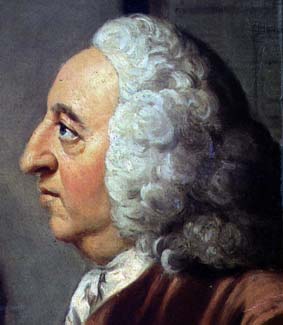
On 7th November 1727, Dr William Oliver[1], the inventor of the Bath Oliver biscuit, wrote to his friend Randolph Marriott[2], D.D., Fellow of Pembroke College, Cambridge, informing him of his recent marriage to Elizabeth Webster.[3]
As a newlywed William was keen to offer his friend advice on choosing a wife and the ingredients for a happy marriage.
In his letter William describes his own struggle to find a suitable wife. He admits that his early searches were very superficial and materialistic, judging women ‘purely for beauty’ or ‘entirely for money’. However, after a fruitless search, he decided that he needed to be more realistic in his approach and ‘sat down seriously to consider in what the true happiness of a matrimonial state was most likely to consist.’ He concluded that the main ingredient for a happy marriage was equality – of ‘age, inclination, quality and fortune, and sufficient of all these to last them their lives.’
The woman who ‘tally’d so well’ with William was Elizabeth ‘Betty’ Webster, to whom he was married on 20th July 1727 at St Pancras Old Church in London. The marriage lasted for 37 years, until William’s death in 1764, and produced five children: four daughters, Elizabeth[4], Charlotte[5], Harriot[6], Susanna[7] and Caroline[8], and a son William[9]. When Elizabeth died in 1768 she was buried alongside her husband at All Saints church at Weston, near Bath, Somerset.
Randolph Marriott evidently took his friend’s advice and on 26th October 1731 he was married to Lady Diana Feilding, daughter of Basil Feilding, 4th Earl of Denbigh.
The following transcript of Dr William Oliver’s letter was first reproduced in SDNQ, vol.13, p.351-2 (December 1913), courtesy of the Rev. L.R.M. Leir[10] of Charlton Musgrove Rectory, Somerset:
‘To the Revd. Mr. Marriott, Fellow of Pembroke Hall in Cambridge.
Bath, November 7, 1727.
Dear Marriott
If I had not been such an unmannerly Cur as not to have thank’d you for the many Civilitys you were so kind as to shew to Mrs Lake on my Account, I shou’d have expected a Letter of Congratulation from you upon the Marriage of your old Acquaintance. But I hope you’ll pardon me and wish well to me for her sake. We scare know enough of Matrimony yet to be able to tell you how we like it, but so much we (I believe both) dare say, that, provided it never proves worse, we don’t wish it better. But I think twou’d be barbarous in any body to describe the Pleasure of a marry’d State to one who can’t conveniently enter into it; and indeed, I think nothing but a very advantageous Match shou’d ever tempt a Fellow of Pembroke to quite so Sweet a Retirement.
I wouldn’t have you imagine that by advantageous I mean nothing abut a great deal of Riches; no; I mean by it a Match that would vastly increase your Happiness, and Such a one is that, in my opinion most likely to be where there is the greatest equality between the Partys of Age, Inclination, Quality and Fortune, and sufficient of all these to last them their Lives. I made diverse and Sundry attempts towards the Unalterable State with as many different views. Sometimes I liked my Mistress better than she did me, another was fond, and I was indifferent. Once I was like to have marry’d purely for Beauty, and twice entirely for money. Tir’d with these fruitless pursuits, and finding that where I was most likely to Succeed I was not thoroughly convinced I was likely to be happy, I sat down seriously to consider in what the true happiness of a Matrimonial state was most likely to consist: the consideration of the nature of the thing itself, and the observation of the several conditions of the persons in it, made me conclude the above-mentioned equality was of all things the most likely to produce it, and having never met with a woman that tally’d so well with me in all particulars as your friend Betty, that determined the match about which I believe you know we had a long time been humming and ha-ing.
I am a sincere well wisher to the old House, and all that belong to it, and I hope they are all well. I wish with all my heart that it was in my Power to spend two or three months in a year with you; but tho’ that is inconsistent with my affairs, your vacations are long enough to let you ramble this way, and I hope ‘twill sometime or other enter into your Head to see the Famous City of Bath and your old acquaintance – without a compliment ‘twould be doing us a Great Pleasure.
Pray present my best respects to good Mr Crossinge, Mr Jeffery and all my friends. I heard when I was in London that Addison[11] had got good preferment, and a rich wife.
I shall be glad to hear of any good that attends him.
Pray give my service to Mr Thirkburn and Mistress, and to my Friend Mr Wall. Is Caleb in College? If he is, I salute him lovingly.
Is Mr Davy still with you?
When you go to the Lodge, pray present my Service to all there. Betty hopes the living is likely to be right.
When you are at Leisure ‘twill be kind in you to let me hear a little Cambridge news. Are you likely to have Solomon’s Temple?
Mr Lake gives you his service, but Nobody is your more sincere Friend than dear Betty, and
Your most affectionate humble Servt.
Wm. Oliver.
Mrs Oliver desires you’ll call on her Aunt Tudway[12] and present her our Duty, and Respects to all that Family.’
Footnotes:
[1] William Oliver (1695-1764) was a born at Ludgvan in Cornwall. He studied at Pembroke College, Cambridge, graduating MB in 1720, and MD in 1725, and completed his medical training at Leiden University. In 1729/30 he was elected a Fellow of the Royal Society. In about 1725, William set up a practice in Bath, where he later set up the Royal Mineral Hospital. He invented a savoury biscuit (the Bath Oliver) for his patient. Dr William Oliver died at Bath on 17 March 1764, and was buried on 23 March 1764 at All Saints church, Weston, Bath, Somerset.
[2] The Rev. Randolph Marriott (c.1698-1782), rector of Darfield, Yorkshire, was admitted to Pembroke College Cambridge in 1716, aged 18. He graduated BA in 1720 and was made DD in 1761. On the 26th October 1731 he was married to Lady Diana Feilding (1706-1756), daughter of Basil Feilding, 4th Earl of Denbigh. The Rev. Randolph died in 1782 and was buried on 6 May 1782 at Darfield, Yorkshire.
[3] William Oliver was married on 20th July 1727 at St Pancras Old Church, London, to Elizabeth Webster (b.c.1706-1768). By her will made on 31 July 1765 & proved on 22 July 1768 (PCC will of Elizabeth Oliver, widow of Bath, ref. PROB 11/941/140), Elizabeth Oliver bequeathed to her daughter Elizabeth Acland, portraits of her grandfather, her Aunt [Susanna] Brattell and her Uncle Webster. By her will proved on 18 May 1763, Susanna Brattell, widow of Enfield, left a bequest of £500 to ‘her dear and only sister Mrs Elizabeth Oliver, wife of Dr William Oliver of Bath’ (PCC will of Susanna Brattell, widow of Enfield, ref. PROB 11/887/873). By her will proved on 30 May 1726, Susanna and Elizabeth’s mother, Susanna Webster of Red Lion Square in the parish of St George the Martyr, Middlesex, left her property to her daughters, Susanna and Elizabeth. Elizabeth Oliver died in 1768 and was buried on 9th July 1768 at All Saints church, Weston, Bath.
[4] Elizabeth Oliver (b.c.1728) was married in 1751 the Rev. John Acland.
[5] Charlotte Oliver (b.c.1728, d.1753) was married in 1752 to Sir John Pringle (1707-1782).
[6] Harriot Oliver (d.1776) was married in 1752 the Rev. Harvey Spragg.
[7] Susanna Oliver was married in 1760 to the Rev. John Benson.
[8] Caroline Oliver, spinster, was executrix to her mother’s will, which was proved on 22 July 1768 (PCC will of Elizabeth Oliver, widow of Bath, ref. PROB 11/941/140). Caroline Oliver was buried at St Swithin’s church, Walcot on 13 November 1792. Further information kindly provided by Ted Robbens suggests that Caroline married Martyn Bird in 1777 and died in 1833 aged 97 (Bristol Mercury, 16 February 1833)
[9] William Oliver (b.c.1730/1). Matriculated from Christ Church, Oxford, on 20 January 1748/9, aged 18, and his name appears on the books at Leiden on 21 September 1753. He was buried at St Swithin’s church, Walcot on 28 July 1801.
[10] Lewis Randolph Marriott Leir (1860-1914), rector of Charlton Musgrove 1886-1914.
[11] Possibly Leonard Addison (1723-1772), Fellow of Pembroke College, Cambridge, was ordained a priest in 1724.
[12] Mrs Tudway may have been related to the composer and organist Thomas Tudway (1650-1726) who was Professor of Music at Cambridge University. Tudway was organist at King’s College, Cambridge, and later at Pembroke College, Cambridge, and the university church, Great St Mary’s.
Visit Spotlight on SDNQ to discover more research themes.